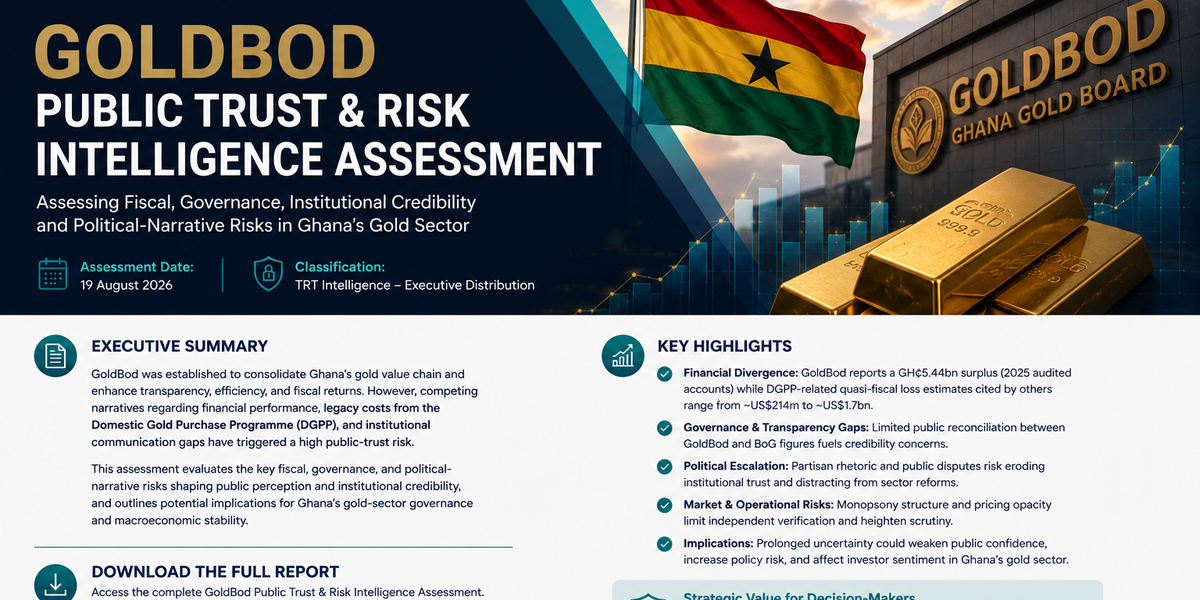
GOLDBOD PUBLIC TRUST & RISK INTELLIGENCE ASSESSMENT
20 Aug 2026
The TRT Intelligence Institute presents an executive assessment of the fiscal, governance, institutional credibility, and political-narrative risks surrounding Ghana's GoldBod. The report examines the unresolved divergence between GoldBod's audited entity-level surplus and disputed Bank of Ghana Domestic Gold Purchase Programme (DGPP) quasi-fiscal costs, and assesses how the resulting uncertainty could affect public trust, institutional legitimacy, investor confidence, and Ghana's gold-sector governance.
Ghana's gold sector is undergoing significant institutional transformation, with GoldBod playing a central role in consolidating the country's small-scale gold value chain. However, competing interpretations of the financial legacy of the DGPP have created a growing challenge to public trust and institutional credibility.
The GoldBod Public Trust & Risk Intelligence Assessment examines the controversy through four interconnected risk dimensions: fiscal exposure, governance and institutional risk, political narrative, and public trust. A central finding is that GoldBod's audited entity-level surplus and the Bank of Ghana's DGPP-related balance-sheet costs represent different accounting perimeters that have not yet been publicly reconciled.
The assessment identifies the absence of a jointly reconciled account as a critical source of uncertainty. Political rhetoric and extensive media amplification have further shifted public attention from the underlying accounting questions toward competing political narratives, increasing the potential for reputational damage to GoldBod, the Bank of Ghana, the Auditor-General and other institutions.
Key areas examined in the report include:
- Public Trust Risk — how conflicting financial narratives may affect confidence in public institutions.
- Fiscal Risk — the potential implications of unresolved DGPP-related costs and Bank of Ghana balance-sheet pressures.
- Governance Risk — mandate concentration, audit scope, parliamentary oversight and cross-institutional coordination.
- Political-Narrative Risk — the competing interpretations surrounding GoldBod's financial performance and institutional role.
- Scenario Analysis — potential stabilisation, persistent contestation and escalation pathways.
- Early-Warning Indicators — signals that could indicate whether the controversy is moving toward resolution or broader institutional escalation.
The assessment concludes that GoldBod is currently facing an emerging institutional risk event rather than an established systemic fiscal or governance crisis. The most important indicator to monitor is whether GoldBod, the Bank of Ghana and the Auditor-General produce a jointly reconciled account of the DGPP's true cost.
The report provides recommendations for GoldBod, policymakers, and risk and intelligence stakeholders, including clearer financial communication, stronger cross-institutional reconciliation, continued monitoring of IMF and Bank of Ghana developments, and systematic tracking of parliamentary and political-narrative developments.
Download the full report below to access the complete GoldBod Public Trust & Risk Intelligence Assessment.